Thursday, 21 January 2010

The art of skiing

Arabella Mileham reviews the Christie's vintage ski poster auction. 

The annual ski sale at Christie’s South Kensington yesterday was a steady, if lacklustre affair. Perhaps it was just bad luck, being the thirteen annual auction of vintage ski posters, but whereas previous sale have seen bidders scrambling for the top lots, this year’s sale totalled just under the £500k mark, with only 70 per cent sold by lot. That's nearly £300k less than the total sale made at the sale's height in 2008.

Traditional favourites proved to be the safest bet, with rarity again realising the highest prices. The top lot of the day was an anonymous 1913 poster of Gstaad's Royal Hotel & Winter Palace (£22,000 including buyers premium), while the visually arresting cover lot, a 1931 poster of Zermatt by Pierre Kramer, came in at £15,000. The stark graphics showing a shadowy ski-jumper set against the Matterhorn had elicited to a lot of interest on the phones. 


 © Christie’s Images Limited 2009

Elsewhere, Emil Cardinaux's domination seemed to have slipped a little to make way for Olympic fever. Two of the top five portrayed the Olympic rings - Gordon Witold's 1932 Lake Placid poster and the 1928 poster by Hugo Laubi, II Olympische Winterspiele at St Mortiz - although ironically, both posters hark from an era before downhill skiing was included as an Olympic sport. 

Since its inception in 1997, the Christie’s Ski Sale has enjoyed steady growth year-on-year with prices far exceeding estimates on some of the top lots. An anonymous 1925 poster of Wengen was the favourite two years in a row, increasing from £16,800 in 2006 to £22,800 only a year later. The most staggering result however came in 2008, when an anonymous Russian poster of 1952, originally estimated at £600 - £800, became a tug-of-war between two bidders and achieved a new record of £36,500.

However, it seems that prices have returned to a more sustainable level and estimates have been very firmly ‘recalibrated’ this year. With the Russian market talking a palpable hit at the onset of the recession, the presale estimate on the same image was a meagre £1,500 - £2,000 which actually proved a little on the generous side. Despite such a gloomy prognosis though, the middle market remained fairly steady and it is still possible to pick up a bargain.

Tuesday, 19 January 2010

Christie's Olympic fundraiser

With the Winter Olympics only weeks away, a charity auction held at Christie’s South Kensington last night helped raise £18,000 towards Team GB’s costs in Whistler. Organised by Snowsport GB and ASK4 Events, the evening was to highlight the work put in by our Olympic Squad as well as to raise funds to support their training and costs. Members of the Olympic teams past and present mingled with snowsport enthusiasts and art aficionados against a backdrop of fabulous vintage ski posters, which will be auctioned next week in the annual Christie's Ski Sale.

There's no denying that Team GB would benefit hugely from an injection of cash, after a summer of financial turmoil for its governing body, Snowsport GB. So with great gusto, Hugh Edmeads, Christie’s Head of International Auctioneering, set about whipping up bids from the assembled throng. However, the party atmosphere seemed to get a tad uncontained and there was furious shushing from strategically placed Christie’s staff at the back of the room.

There are now less than three weeks to go before the Winter Olympics start in Vancouver and the athletes are firmly concentrating on those few moments that will determine whether they earn their place on the podium.

Wednesday, 13 January 2010

Huskies and canyons

Arabella Mileham recovers her aching muscles with a spot of canyoning in the Leutasch Valley - January 13, 2010

Oh, I can also definitely feel muscles that I was not aware of before today! Stupidly, I wasn’t quick enough of the mark when we arrived and failed to book a massage - a quick swim and a sauna had to suffice for my aching limbs before dinner in Seefeld. After wandering through the picturesque centre of the little town, snow softly falling all around, we came to the Krachelemoos, a fab restaurant tucked away in a corner side street. This originally started life as two farmhouses several hundred miles apart, but they were carefully demolished and rebuilt in the centre of Seefeld. As well as the atmospheric decor, the food itself was absolutely fantastic – a particularly mouthwatering shashlik of pork on creamed Savoy cabbage with a traditional slice of surprisingly light Tirolean dumpling. The description barely does it justice - I haven't had anything so beautifully cooked for ages - but this was followed by apfelstudel with a cinnamon and toffee ice-cream and the now obligatory schnapps.

After the strenuous activity of yesterday, today’s plan of snow shoeing and dog-sledding with www.tirolalpin.at Tirol Alpin sounded a lot more chilled. However, I hadn’t reckoned on being leashed to Maggie, the most inconsistent and noisy husky on the planet. She didn’t get off to a brilliant start by lying down in the snow to have her tummy scratched and it soon became clear that she just wanted attention - running up the hill with me lumbering after in my unwieldy snow shoes only to stop dead and wait for me, just as the gradient increased. After the first hill, she was relegated to the sled and I was attached to a rather less high-maintenance dog to enjoy the walk through the walk. Tramping through the trees in the woods behind Kirchplatz was lovely – so rarely do you get to wander quietly and just enjoy the scenery rather than whizzing past it. However our destination was a gorge further up in the forest for a spot of canyoning.


Now, I have to admit that I’m a bit of a wuss when it comes to throwing myself off cliffs. I probably shouldn’t be as I spend half of my childhood clambering over rocks, climbing trees and swinging across the garden on ropes, but I generally prefer to hold on wherever possible! The zip-wire across the gorge was great fun but I was distinctly less keen on the 40m abseil when we got to the other side. But a girl’s gotta do what a girl’s gotta do. So with jelly legs and a white face, I braved it for the descent. There was quite a large over-hang so I ran out of cliff to walk down after 15m or so and it was with undignified relief that I reached terra firma and was able to clip myself onto the ropes strung across the rocks.
As it was pretty nippy so we didn’t explore the canyon for very long and emerged at the top to a picnic, complete with tea mit rum and a rather good schapps. (It seems that anytime is schnapps time in Tirol!) After racing home through the trees on the dog sleds, there was time for a quick coffee before collecting our stuff for our final cross-country trail.

We’d already pumped Steve, the Headwater rep, for information about where to go, so armed with maps and cross-country skis and with the light slightly fading, we were dropped off at Moos for our 5km langlauf home. Our route took us along the floor of the valley with views over the Wetterstein to our left. After a great deal of faffing getting into our skis, we made quite good time and became so mesmerized concentrating on the tramlines in front of us that we only stopped for a quick hot chocolate when we were in sight of Kirchplatz - about 5 mins from home. Perhaps it wasn’t such a good move as sitting down made my newly discovered muscles start to seize up and it was with great difficulty (and not a little swearing) that I clipped my skis back on for the final 200 yards towards home.

I think next time I go cross-country skiing, I might spend a little bit longer preparing my pretty pathetic leg muscles. The Vikings who allegedly invented this great sport were probably a darn sight hardier than I am!
First published on welove2ski.com

Tuesday, 12 January 2010

Bambi on skilaufs

Arabella Mileham tries her hand (as well as her arms and legs) at a spot of cross-country skiing in Leutasch in the Austrian Tirol - January 12, 2010

Tucked in a corner of Olympiaregion Seefeld, 25km northwest of Innsbruck, the Leutasch valley and neighbouring Seefeld is a mecca for cross-country skiing. I headed out for a few days with some seasoned ski journalists, eschewing my normal downhill in favour of this ancient, Nordic sport.

Innsbruck was unusually snowy when we landed and the white stuff was still falling as we arrived at the Sporthotel Xander, in Kirchplatz after the shortest possible transfer– a smooth and painless 45 minutes after touching down. It had been very peculiar flying over a snowy Britain on an almost empty Easyjet flight (an unheard of combination) en route to the Tirol so this made it a hat-trick of unusual proportions.


Although we were primarily here for the cross-county, a visit to the Alps wouldn’t be complete without a little downhill, so Tuesday morning saw us up, bright and early, making out way down the road to Rosshütte, to check out the local slopes at Seefeld. It's only a ten minute ride by car down the valley, so pretty painless. After all the snow the night before, it was beautiful groomed corduroy all the way, with some great powder to the sides of the pistes.

I probably should have put my nice, fat all-mountain Salomon Tornado Extremes through a darn sight more gruelling test, but as the first run since April last year (and after a few schnapps the night before) I was very restrained on the powder-front.
It was a pretty blinking cold -9 degrees up top but gloriously sunny – my teeth were definitely the coldest part of me because I was grinning so much to be back on the slopes.

We worked our way around the slopes of Rosshütte with our knowledgeable and charming guide (the head of the Tourist Office for the region, no less) and ripped down virtually empty pistes towards queue-less chairs, only stopping for a brief and very welcome der Kakao mit ruhm at the new Rosshütte restaurant. As well as the new café and terrace, the lifts have been upgraded over the last three years to speedy six-chairs, although the Seefeld Jochbahn is still a dinky, red phonebox style, 12-person gondola. Although it’s a bit of a tight squeeze, it was worth it for the views over the spectacular Karwendel Nature Park to the northeast and Wetterstein mountains, as well as the only black run of the area.

Looking towards the Karwendel national park

Over the other side of the valley at Hamelekopf, we could see some interesting lines off-piste down a jaggedy couloir, but apparently the off-piste can be unpredictable and it is not readily encouraged. However, the top of the route yielded some beautiful, ungroomed powder, on the way to lunch at the Reitherjoch Alm. We rounded off the feast with a massive shared skillet of ‘Kaiserschmarrn’ – a whopping Tirolean caramelised fluffy pancake, liberally soused with icing sugar and served with apple puree. A main course in its own right, it’s completely delicious but probably highly dangerous to the waistline -a few spoonfuls each were more than enough to send us pelting through the trees, to the alarm of the locals walking up, and down the final run towards town.
A quick scoot across town and a boot swap later, we were kitted out and ready for our first foray into langlaufing. There are two styles of cross-country, classic and skating, and we were going for the former, apparently the most efficient way to move across a flat area of snow - although maybe not the way I was doing it! The Cross Country Academy in Seefeld is situated by the Seekirchl and Olympicabad, by the entrance of one of the many cross country trail and run by former Olympic medallist, Martin Tauber. The upside of this is great tuition but the downside is that they make it looks so damn easy while you’re slipping Bambi-like across the frozen plains.
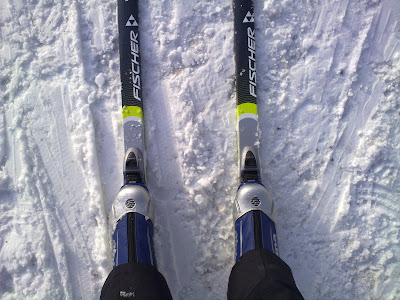
Bambi on skilaufs – how the hell do you stay upright?
Although the boots are a lot comfier than their Alpine counterparts, I felt horribly precarious perched on top of my ridiculously thin skis. Settling into tramlines cut in the snow of the trail made it a lot easier to keep boot, knee, and nose in line while walking in arabesque. However, by the time I’d worked up enough steam to light up Oxford Street, I started to get into some sort of rhythm, swinging one arm forward, the opposite leg back and slightly bouncing on the middle of my ski to prevent myself slipping backwards. (they are softly rippled on the underside which is supposed to help) This was fine, after a fashion, on the level but far less effective when faced with a slope. However, after an hour and 40 minutes, we’d done a mind-boggling 7km around the course, stopping only to look at the Olympic ski jump and check out the new biathlon range.


Star pupil or sympathy hug, you decide

Although it was a huge fun, I fear in will be agony tomorrow no matter how many hours I spend in hotel's steam room.

Arabella travelled to Austria with Headwater on the “Cross Country Skiing in Leutasch and Seefeld” holiday. Prices of start at £1,009 per person for seven nights 4* accommodation at the Hotel Xander including breakfast and dinner, ski equipment hire (skis, boots and poles) and a guided ski programme with a Headwater resident representative. With flights and transfers, prices start from £1,187 per person Gatwick to Innsbruck with Thomson Airways, or can be arranged from most UK airports.

First published by welove2ski.com

Monday, 2 November 2009

London Freeze

Urban snow, big air and world class tricks returned to the capital at the LG London Freeze.

Despite Sunday’s dismal weather, the whopping 35m, 100m long real-snow kicker saw plenty of action at this year’s LG London Freeze. The site in front of Battersea Power station was packed out for the three day snowsport and music festival for the second year running. More than 12,000 people turned up to see the big air competitions as well as bagging a bargain, soaking up the resort atmosphere and enjoying live sets from Orbital, Eagles of Death Metal and Friendly fires.

Battle of Britain
The Battle of Britain on Friday saw the best British skiers and riders slug it out for a place in the International Style Mix Competition. Snowboarders Gary Greenshields and 16-year-old Jamie Nicholls topped the Brits in the morning but were knocked out by the powerful Scandinavians in the evening’s finale. Finland’s Roope Tontieri went on to scoop the top prize.


Paddy Graham won the skiing Battle of Britain with 17-year-old James ‘Woodsy’ Woods coming second and joining him in the Style Mix. Both Brits put up a great show, but Woodsy was knocked out in the head-to-head and Paddy Graham’s backflip in the second round delighted the crowd but failed to win over the judges. It was Bobby Brown's whopping second run jump in the finals which triumphed, beating über-collected, headphone-wearing Canadian, Phil Casabon.

LG FIS Snowboarding World Cup
The festival cranked up a notch on Saturday with a buzzing atmosphere for the LG FIS Snowboarding World Cup. There were some serious tricks on the ‘kicker of awesomeness’, the frontside 900º (a two and half turn rotation) being a particular favourite of the athletes. There was a fair sprinkling of 1080º s, some very impressive 1260ºs and the odd double-cork rotation thrown in for good measure (in which a rider turns himself upside down twice during the aerial spin).

British Olympic hopeful Ben Kilner’s inverted backside 720º was not enough to get him through to the final, although he finished a very respectable 14th out 53 competitors. It was Finland’s Stefan Gimpl’s slick jumps and perfect landing which took him to the top of the competition, proving experience wins over youth.

Later on, it was the turn of the Americans to dominate the final challenge, the rails. Meanwhile Calvin Harris kept the music pumping from the Main Stage, followed by the much anticipated return of legendary band, Orbital, who played well into the night.


International Big Air Ski and Snow
Despite howling gales and the rain turning snow to mush overnight, the International Freeski competition went ahead on Sunday, albeit drastically delayed. The snow maintenance crew had been up since 4 am but it was well into the afternoon before the kicker was ready. High Altitude’s Ed Leigh and Christian Stevenson of Kerrang!Radio kept the waiting crowd entertained, racking up the tension as Woodsy, ‘volunteered’ by the rest of the pros, had the dubious honour of testing the jump. After landing safely to roaring approval, the Big Air Freeski kicked off in earnest.
Ed and Christian
However, although the tricks came thick and fast and usually appeared effortless, the dangerous reality of the aerial rotations became painfully obviously when Ritchie Permin had a big fall in the heats. Landing heavily on his side, he was attended to by the paramedics but had to be stretchered off the piste.

Following Permin’s exit, Ed and Christian whipped up the support of the shaken crowd and the show got back on track. Discarding the second heat head-to-head due to the late start, 32 pros were soon whittled down to eight for the finals. None of the UK hopefuls made it through, despite a valiant effort from Woodsy, Joe Tyler and Paddy Graham.

Woodsy, loving the home crowd
Scores were well into the 90s for the nail-biting finale, the athletes spurring each other onto even more impressive spins. Bobby Brown, Andreas Hatveit and Russ Henshaw battled it out for the top spots. Brown’s awesome switch 1260º earned a whopping 98 points from the judges but a huge double back from Henshaw stormed into the lead and won the top prize. On collecting his £4,000 prize he admitted that he only decided which trick to perform seconds earlier when he saw Brown’s massive jump.

The three day extravaganza of music, snow and ski drew to a close with the focus returning back to the main stage where band of the moment, Friendly Fires, wowed the crowds.

If you missed the action from this year’s Freeze, you can catch up with the highlight from Battersea on Channel 4’s Freesport on 4, which will be broadcast on Sunday 15th November.


Tuesday, 8 September 2009

Is the ski industry plunging out of control?

News of luxury chalet company Descent International going into voluntary liquidation has sent skiers into a frenzy of speculation about the coming season. As the first snow falls over the Alps, predictions of industry meltdown reverberate around the blogosphere, prophesying the end of ski civilisation as we know it. But does the demise of a small, high-profile company doom skiers to a winter of discontent?

Descent International was founded in 1997 and took chalet holidays into another realm. As famous for its clientele as its high-spec properties and attentive service, it was seen by many as the ultimate company to stay with, promising a team of professional staff on hand to cater for your every whim. The failure of such a strong brand has exacerbated fears that other companies may follow suit, leaving little protection for clients as many companies at the top-end of the market are more exposed to financial risk. Although bonding scheme exist to protect bookings, few smaller companies include flights in the package, which would offer protection through the Air Travel Organiser License (ATOL) or Association of British Travel Agents (ABTA).

Mark Gibbins, director of luxury agency The Oxford Ski Company, has noticed a certain amount of hesitancy this season. “Levels of enquiries are as busy as ever but there’s a massive hole in consumer confidence. When a big brand like Descent goes under and there’s a lot of bad press, people are very concerned about booking with smaller operators. Whereas before we would have four or five enquiries a year about bonding and ABTA, now every other booking is asking that question.”

In spite of the negative publicity steady, a pick up in booking suggest that people still want to go skiing. However there has been a subtle shift in attitude away from conspicuous consumption – few people want to be seen spending frivolous sums of money at a time of economic retrenchment. But trimming the budget doesn’t necessarily mean forgoing high standards. Luxury chalets tend to come with a professional chef, dedicated nannying services, and a round-the-clock driver as standard, with many offering a private ski guide or instructor, a well-stocked cellar and the very latest technical wizardry. “Five years ago one of the must-haves was a hot tub; now it is a private indoor pool," reflects Gibbins.

"We’re finding that people are happy to spend money but want to make sure they are getting the best value they can,” he says. "People are generally looking to broaden their horizons and realising that they can get more for their money if they look outside their usual resort. Ultimately though, they still want the standard they are used to."

This has started a fundamental shift in the way that the industry operates. While some operators have cut back the operations in order to consolidate their bookings, others are looking to see where their business models can be improved, providing a wake-up to chalets owners as much as to the ski companies themselves

“For years owners have been demanding astronomical amounts of rent for their properties and the only way for a company like Descent International to make a profit was to charge very high prices. Many companies have gone back to renegotiate with the chalet owners and as a result, companies can create more of a margin and offer their clients greater value,” said Gibbins.

It is the smaller companies at the top end of the market that are currently leading the way, entering partnerships and sharing the risks with the owners. Brambleski Verbier is one company that adopted this model several years ago. Director Duncan Robertson explains how this works. “Many businesses are simply looking to hammer down the owners on the rental price but we have tried to compensate by offering owners increased rental potential for increased risk sharing. I do think there is going to be a shift towards owners taking on increased involvement in the business models. We only pay rent for the weeks that we sell at our chalets rather than being locked into longer-term annual guaranteed rents. With a far lower fixed cost base than some of our competitors, we can weather the recent financial crisis better.

“Partnerships reduce the risk of the chalet operator going under and increase the safety of their rental income in the longer term. Chalet operators may have to accept reduced margins on individual weeks sold but this will be offset by reducing losses from discounting or voids. Ultimately it’ll give them increased financial stability.” says Robertson.

Gibbins agrees: “There are so many private properties and small companies out there that offer the same level of service as Descent and a bit more personality. Previously people just wouldn’t consider because them because they didn’t have that brand strength behind them.”

However brand-strength has proved no more of a guarantee of safety than anything else and increasingly, chalet owners are being temped away from the easy chalet company model to go it alone. Out of the 14 Descent chalets, the Oxford Ski Company is still able to offer nine to its clients this season, working directly with the owners.

“Although the bad press has been detrimental, everyone I’m speaking to is very positive," says Gibbins “This news has made everyone think about they are offering, which in turn provides more choice for the consumer. After a cautious summer, confidence in the economy is improving. The current climate has benefited my clients – they are getting more for their money than they have in the last two years."

So, as long as the snow is good and you can throw in a little flexibility, the prognosis for skiers this season seems far from gloomy.

Sunday, 30 August 2009

Review - Shall we dance at Sadler's Wells

Fourteen years after wowing London as the lead in Matthew Bourne’s all-male Swan Lake, Adam Cooper has gone from Royal Ballet rebel to established West End choreographer. His new show, Shall we Dance at Sadler’s Wells, is a tribute to Richard Rodgers, the legendary Hollywood composer and one of the most influential artists of the 20th century.

Cooper’s fascination with musical theatre was first evident in his exciting staging of Rodger’s On Your Toes in 2003. Originally choreographed by George Balanchine, Rodger’s 1936 Broadway production showed him to be a champion of dance, a role now filled by Cooper. Although a talented choreographer, this time around Cooper seems caught in a no-man’s land between classical dance and variety performance. With a varied ensemble cast, the production is lacklustre, neither one thing nor the other.

Although Cooper has tried to weave a largely unconnected storyline together through imaginative linking vignettes, this only highlights the dislocation of the whole. As the hero, he travels from shore to shore in search of his Dulcinea, by turn brooding and joyful. His numerous affairs take him from the Jazz clubs of London to a Viennese ballroom, a Russian wedding, the Orient and Wild West before finding his true love just off Ninth Avenue. However, his performance does not provide a strong enough thread to unite these different elements and only rarely do we see flashes of his former brilliance and stage presence.

The production is also let down by the limitations of some of the leading ladies. Emma Samms, who receives top billing as the vampish Swing girl, is deeply unconvincing. Best remembered as Fallon in Dynasty, her dancing is brittle and lacks both sensuality and drama. It's not all bad though: Lorraine Stewart is lovely in the Viennese waltz but it is Sarah Wildor, former principal at the Royal Ballet (and Cooper’s wife), who stands at the heart of the piece, despite a hideous costume. Her musicality and acting skills lend vulnerability and provides an emotional punch to an otherwise superficial spectacle. Slaughter on Ninth Avenue, her pas de deux with Cooper, shows the only moment of real depth in the entire programme. As a gunshot fires across the stage, she slumps, slightly quivering, in his arms. Sadly, only moments later the magic is completely lost when our hero finds the Right girl in brassy Ebony Molina.

The simplicity of the set design and use of colour is extremely effective. A circular section of the stage revolves, slickly moving tables and chairs around the Jazz café and turning the ballroom staircase into the stern of a liner while the dancers move around the space. The orchestra sits on a raised dais at the back of the stage forming part of the backdrop. The score itself moves seamlessly between musical numbers, woven together with great skill by Richard Balcombe. The hoedown medley is by far the best set piece, its sheer exuberance fuelling the performers as the hits from every musical come thick and fast.

Although I enjoyed the performance, it is hard to ignore its limitations. Neither ballet nor musical, the story is not strong enough to support such a varied programme without a central leading performance, which Cooper mysteriously fails to provide. Unlikely to satisfy serious balletomanes, Shall we dance will none-the-less plug the gap for those of us waiting for the return of Strictly.